

A health network accuracy platform helps health plans maintain accurate provider directory data through automated verification, real-time updates, and compliance reporting. By improving provider data accuracy, these platforms enhance member experience, reduce regulatory risk, and streamline healthcare network management.
A health network accuracy platform is a specialized software solution that helps health plans and insurers maintain up-to-date, verified provider directory data. These platforms reduce compliance risk, improve patient experience, and streamline provider data management through automated verification, real-time updates, and regulatory reporting tools.
Every year, millions of Americans use their health plan’s provider directory to find an in-network doctor—only to discover the information is wrong. The physician has moved. The specialist no longer accepts their insurance. The clinic listed closed two years ago. This problem, known as “ghost network” inaccuracy, costs the U.S. healthcare system billions in misdirected care and erodes patient trust at a fundamental level.
For health plans and managed care organizations, the stakes are high. The Centers for Medicare & Medicaid Services (CMS) and state regulators have significantly tightened provider directory accuracy requirements over the past decade, with non-compliance penalties reaching into the millions. Meanwhile, patients who can’t find accurate, accessible care are more likely to disenroll, file complaints, or seek legal recourse.
A health network accuracy platform addresses these challenges head-on. By automating provider data verification, centralizing directory management, and generating compliance-ready reporting, these platforms give health plans the infrastructure they need to maintain accurate, trustworthy provider networks at scale.
This guide covers everything you need to know—from what a health network accuracy platform does, to how it supports provider directory compliance, and what to look for when evaluating solutions for your organization.
What Is a Health Network Accuracy Platform?

A health network accuracy platform is a purpose-built software solution designed to collect, verify, standardize, and continuously update provider data across a health plan’s network. The platform acts as a central source of truth for provider directory information, ensuring that members, regulators, and internal teams are all working from the same accurate dataset.
Unlike general-purpose data management tools, health network accuracy platforms are built specifically for the complexity of healthcare provider data. Provider records are notoriously dynamic—physicians change affiliations, retire, relocate, and update their specialties regularly. A platform purpose-built for this environment handles that complexity through automated outreach, data matching, and real-time verification workflows.
Key capabilities typically include:
- Provider data ingestion from multiple sources (provider-submitted data, claims data, credentialing systems, and third-party databases)
- Automated verification of provider demographics, practice locations, accepting new patients status, and insurance participation
- Discrepancy detection and resolution workflows that flag outdated or conflicting records
- Compliance reporting aligned with CMS, NCQA, and state-specific requirements
- Member-facing directory publishing with configurable search and filtering tools
Why Provider Directory Accuracy Is a Critical Health Plan Priority
The provider directory is one of the most patient-facing assets a health plan manages. When a member needs care, the directory is often their first point of contact with the network. Inaccurate data at this moment—a wrong phone number, an incorrect address, or a provider listed as in-network who isn’t—creates immediate harm.
From a regulatory standpoint, CMS has made provider directory accuracy a core compliance requirement for Medicare Advantage and Marketplace plans. The CMS Medicare Advantage program requires plans to verify provider information at least every 90 days and update directories within 30 days of a confirmed change. State Medicaid and commercial insurance regulators have implemented similar—and in some cases stricter—requirements.
Non-compliance carries real consequences. Health plans can face corrective action plans, civil monetary penalties, and in severe cases, suspension of enrollment. The reputational damage from a pattern of inaccurate directories can be just as damaging to long-term enrollment growth.
Beyond compliance, provider directory accuracy is directly tied to network adequacy—a measure of whether a health plan’s network provides sufficient access to care. Regulatory bodies assess network adequacy using directory data. If that data is inaccurate, a plan may appear adequate on paper while members face genuine access barriers in practice.
How Healthcare Provider Network Management Has Evolved
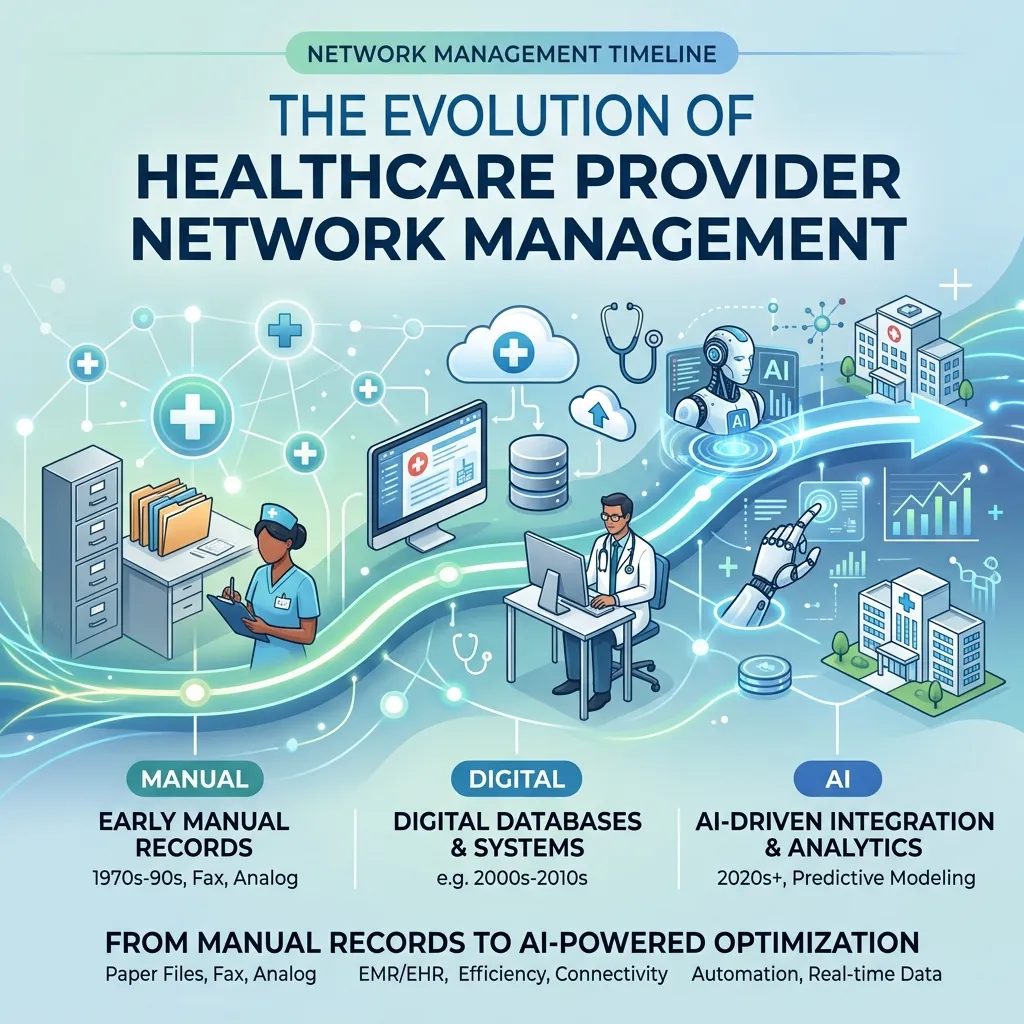
Managing a provider network used to mean maintaining a database of contracted providers and updating it periodically. That approach no longer works. Provider networks today are larger, more complex, and more geographically dispersed than ever—and the velocity of change in provider data has increased significantly.
Several factors have accelerated this evolution:
Consolidation in provider markets. Health system mergers and acquisitions mean that a single contracting event can affect hundreds of provider records simultaneously. A platform that monitors organizational changes and cascades updates across affiliated providers is far more efficient than manual record-by-record updates.
Multi-channel directory requirements. Health plans must now publish accurate provider information across web directories, mobile apps, call centers, and third-party platforms. Maintaining consistency across all channels without a centralized platform is operationally unsustainable.
Value-based care and narrow networks. As health plans build tiered and narrow networks to drive members toward high-value providers, the accuracy of network tier designations becomes critically important. Placing a provider in the wrong tier—or failing to remove one who no longer qualifies—can expose the plan to both member dissatisfaction and compliance risk.
A modern health network accuracy platform is designed to keep pace with all of these dynamics, not just manage static data.
What Does Provider Data Verification Actually Involve?
Provider data verification is the process of confirming that information in a plan’s provider directory is current and correct. It sounds straightforward, but the execution is complex.
Verification typically spans multiple data points per provider record:
- Demographic data: Name, NPI, specialty, gender, languages spoken
- Practice location: Address, suite number, accessibility features, hours of operation
- Contact information: Phone, fax, and online scheduling availability
- Network participation: Whether the provider is actively accepting new patients within the plan’s network
- Credentialing status: Current licensure, board certifications, and any disciplinary actions
Health plans traditionally relied on annual or semi-annual outreach campaigns—mailing or calling providers to confirm their information. This approach has significant limitations: low response rates, outdated data between cycles, and enormous administrative burden.
A health network accuracy platform replaces or augments this manual process with:
- Automated outreach via email, SMS, and provider portal
- Data matching against authoritative sources like NPPES (National Plan and Provider Enumeration System), state licensing boards, and DEA registries
- Continuous monitoring that triggers re-verification when changes are detected in source data
- Provider self-service portals that make it easier for providers to update their own information directly
The result is higher data quality maintained at lower operational cost.
Health Plan Provider Directory Compliance: What the Rules Require

Compliance with provider directory accuracy regulations is non-negotiable for health plans participating in federal or state programs. The regulatory landscape spans multiple frameworks:
CMS Medicare Advantage and Part D: Plans must verify all provider information at least every 90 days and publish updates within 30 days of confirmed changes. CMS conducts regular audits and publishes plan-level accuracy scores.
ACA Marketplace plans: The ACA requires qualified health plans to maintain accurate, up-to-date provider directories as a condition of marketplace participation. HHS reviews directory accuracy as part of plan certification.
NCQA accreditation standards: For plans seeking NCQA accreditation, provider directory accuracy is a scored element. NCQA’s standards require documented processes for ongoing verification and discrepancy resolution.
State-specific requirements: Many states have enacted their own provider directory laws, some of which are more stringent than federal standards. California, New York, and Texas, for example, have specific requirements around update frequency and member notification when a provider leaves a network.
A health network accuracy platform supports compliance across all of these frameworks by maintaining audit trails, generating regulatory reports, and flagging records that are overdue for verification.
Choosing the Right Healthcare Data Accuracy Platform
Not all health network accuracy platforms are built the same. When evaluating solutions, health plans should assess the following dimensions:
Does the platform support real-time data verification or only batch processing?
Real-time verification is more effective at catching changes as they happen. Batch-based platforms may leave outdated records in the directory for weeks or months between processing cycles.
How does the platform handle provider outreach and response management?
Look for platforms that offer multi-channel outreach (email, SMS, portal), automated follow-up, and configurable escalation workflows for non-responsive providers.
What data sources does the platform integrate with?
The most effective platforms aggregate data from multiple authoritative sources—NPPES, CAQH, state licensing boards, credentialing systems, and claims data—to validate provider records against independent references.
How does the platform support member-facing directory publishing?
Choose a solution with configurable, API-accessible directory publishing capabilities that support multiple channels and comply with accessibility standards.
What reporting and audit trail capabilities does the platform offer?
Compliance documentation is only valuable if it’s comprehensive and auditable. The platform should generate submission-ready reports for CMS, NCQA, and state regulators, with full version histories of record changes.
The ROI of Investing in a Health Network Accuracy Platform
The business case for a health network accuracy platform extends well beyond avoiding penalties. Consider the cumulative impact of directory inaccuracy on a health plan’s operations:
Member services costs: Inaccurate directories generate call center volume as members seek help finding in-network providers. Each misdirected call has a measurable cost per contact.
Claims disputes: When members receive care from providers they believed were in-network—based on directory information—and receive out-of-network bills, the resulting disputes require significant administrative resources to resolve.
Enrollment risk: Member satisfaction surveys consistently identify provider access and directory accuracy as key factors in enrollment decisions. Plans with chronic directory problems face higher disenrollment rates.
Audit remediation costs: When CMS or a state regulator identifies a pattern of directory inaccuracies, corrective action plans impose additional reporting requirements and administrative burdens that can last for years.
A health network accuracy platform addresses all of these cost drivers systematically, delivering ROI through reduced operational costs, lower regulatory exposure, and improved member retention.
Building a Future-Ready Provider Network
The regulatory and operational pressures around provider directory accuracy are not going away. If anything, the trajectory points toward more frequent verification requirements, greater transparency obligations, and higher member expectations for real-time directory accuracy.
Health plans that invest in a robust health network accuracy platform now are building the infrastructure to meet those demands as they evolve. The organizations that continue to rely on manual processes or legacy systems will face an increasingly difficult compliance environment—and the patient trust consequences that come with it.
Accurate provider data is foundational to everything a health plan does: network contracting, member communication, care coordination, and regulatory compliance. Getting it right isn’t a back-office function. It’s a strategic priority.
Frequently Asked Questions
What is a health network accuracy platform?
A health network accuracy platform is a software solution that helps health plans verify, manage, and publish accurate provider directory data. It automates provider outreach, integrates with authoritative data sources, flags discrepancies, and generates compliance documentation for regulators like CMS and NCQA.
Why is provider directory accuracy so important for health plans?
Inaccurate provider directories create barriers to care for members, expose health plans to regulatory penalties, and increase administrative costs through call center volume and claims disputes. CMS and state regulators now require health plans to verify and update provider information on a continuous basis.
How often do health plans need to verify provider data?
CMS requires Medicare Advantage plans to verify all provider information at least every 90 days and update directories within 30 days of a confirmed change. State and commercial requirements vary, but the trend across all markets is toward more frequent verification cycles.
What is the difference between provider data verification and credentialing?
Provider credentialing is the process of assessing a provider’s qualifications, licensure, and history before granting network participation. Provider data verification is the ongoing process of confirming that directory information—location, contact details, network status—remains accurate after credentialing. Both are necessary, but they serve different functions.
How does a provider data management platform reduce compliance risk?
By automating verification workflows, maintaining audit trails, and generating regulatory reports, a provider data management platform ensures that health plans can demonstrate ongoing compliance with CMS, NCQA, and state directory accuracy requirements—reducing the risk of penalties and corrective action.
What features should I look for in provider directory management software?
Key features include multi-source data integration (NPPES, CAQH, state licensing boards), automated provider outreach and response tracking, real-time discrepancy detection, configurable member-facing directory publishing, and compliance reporting tools aligned with CMS and NCQA standards.