

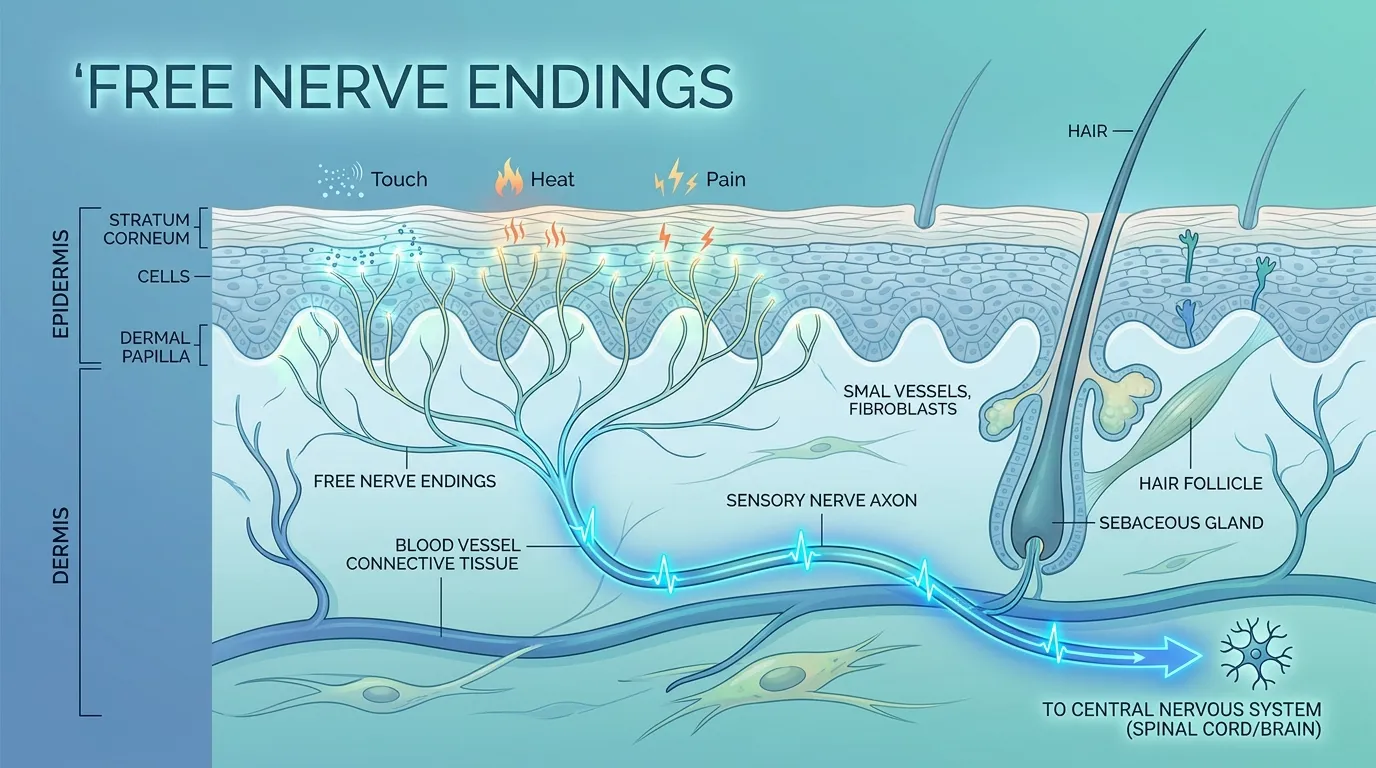
Free nerve endings are specialized sensory receptors that help the body detect pain, temperature, touch, and itch. Found throughout the skin, organs, muscles, and other tissues, they act as the body’s early warning system by converting harmful stimuli into nerve signals. Understanding how free nerve endings function provides insight into pain perception, sensory processing, and the vital role they play in protecting overall health.
Free nerve endings are bare sensory receptors in your skin and tissues that detect pain, temperature, and touch. Unlike other receptors, they have no protective capsule, so their nerve tips sit exposed and ready to respond to stimuli. They are the main receptors behind pain perception (nociception) and your sense of hot and cold.
Touch a hot stove, and you yank your hand back before you even think about it. Step on a sharp rock, and a jolt of pain shoots up your foot. Behind these split-second reactions sits a quiet army of sensory structures called free nerve endings.
These tiny receptors are some of the most widespread and important sensors in your body. They tell you when something is too hot, too cold, or downright dangerous. Without them, you could burn, cut, or injure yourself without ever noticing.
This post breaks down what free nerve endings are, how they work, and the vital role they play in sensation. You’ll learn how they detect pain and temperature, where they sit in the body, and how they fit into the bigger picture of your nervous system. Let’s dig in.
What is the function of free nerve endings?
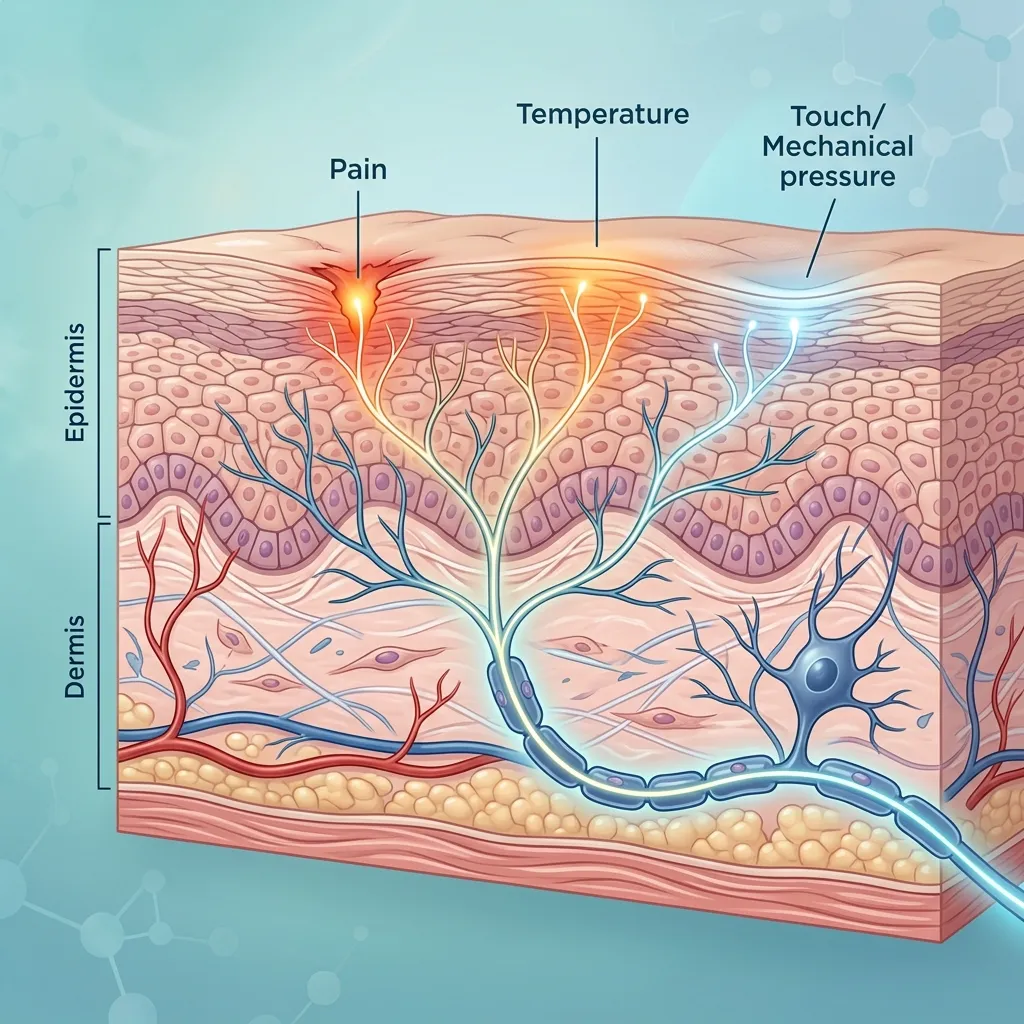
Free nerve endings are the exposed tips of sensory neurons that detect a wide range of stimuli. Their main job is to convert physical or chemical signals—like heat, pressure, or tissue damage—into electrical signals your brain can understand. This process is called transduction.
The word “free” refers to their structure. Most have no specialized capsule or covering around them. Instead, the nerve tips branch out freely into the surrounding tissue. This bare design lets them respond directly to changes in their environment.
Free nerve endings handle several types of sensation:
- Pain: They warn you of injury or potential harm.
- Temperature: They sense both heat and cold.
- Touch: Some detect light pressure and movement.
- Itch: They also play a role in the itching sensation.
Because they cover so many sensory bases, free nerve endings are considered the most abundant type of sensory receptor in the body.
What role do free nerve endings play in sensation?
Sensation begins when a stimulus activates a receptor. Free nerve endings act as the first point of contact for many of these signals. When you touch something sharp or hot, the free nerve endings in that area fire off an electrical impulse.
That impulse travels along the sensory neuron toward your spinal cord and brain. Your brain then interprets the signal and decides how to respond. All of this happens in a fraction of a second.
Think of free nerve endings as the body’s early warning system. They constantly monitor your skin and internal tissues for anything unusual. When they detect a threat, they sound the alarm—prompting reflexes, behavior changes, or conscious awareness of discomfort.
This protective role matters more than it might seem. People who are born unable to feel pain, due to rare genetic conditions, often suffer serious injuries because their warning system doesn’t work. Free nerve endings keep you safe by making sure you notice when something is wrong.
How do free nerve endings detect pain and temperature?
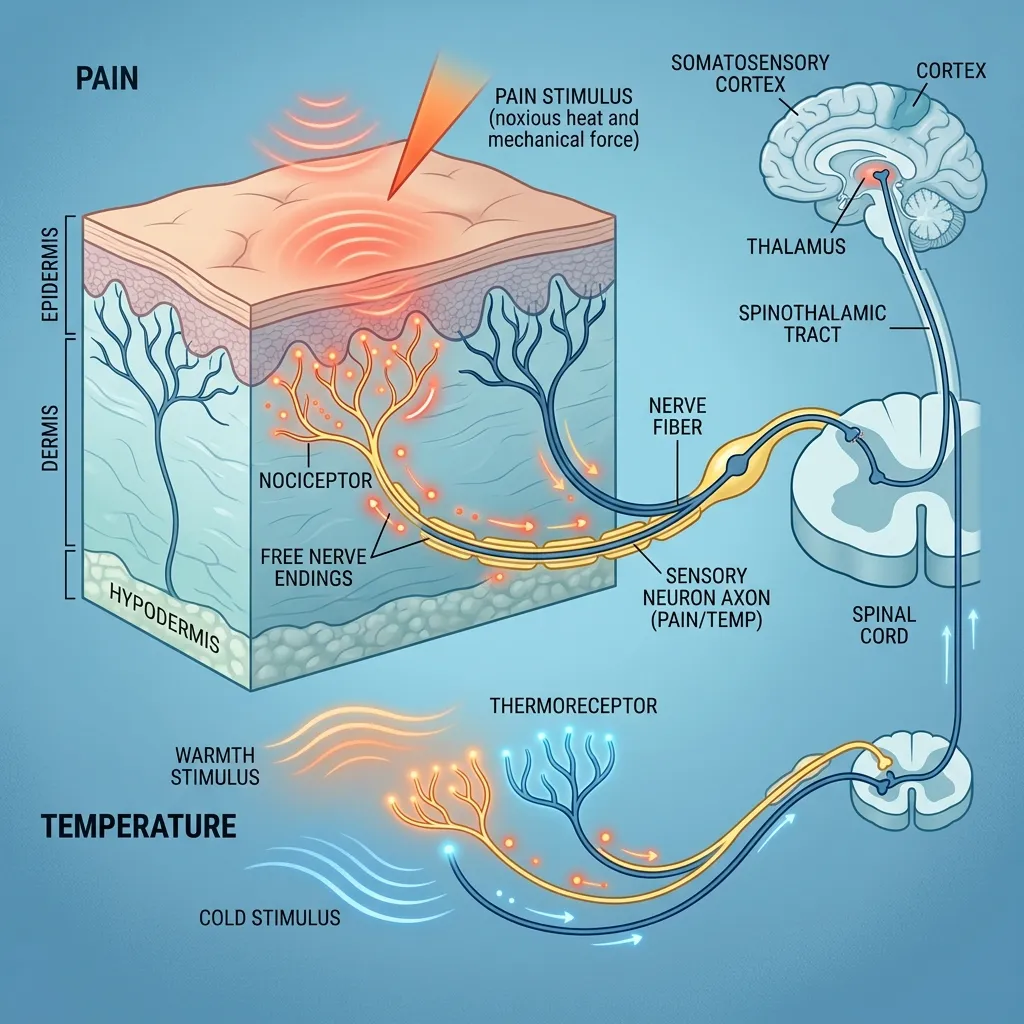
Free nerve endings rely on special proteins called receptors and ion channels embedded in their membranes. These channels open or close in response to specific triggers. When they open, charged particles flow into the nerve and create an electrical signal.
Pain and temperature receptors in the skin
Your skin is packed with free nerve endings tuned to different sensations. Some respond to heat, others to cold, and many to painful stimuli. Certain ion channels, known as TRP channels, are especially important here.
For example, one type of TRP channel reacts to high temperatures and to capsaicin—the compound that makes chili peppers feel hot. Another reacts to cold temperatures and to menthol, which is why mint feels cool on your skin. These channels explain why a spicy meal can feel “hot” even when nothing is actually burning you.
How free nerve endings detect pain
Pain detection starts when tissue is damaged or threatened. Injured cells release chemicals like prostaglandins, bradykinin, and potassium ions. Free nerve endings sense these chemicals and fire a pain signal.
There are two main waves of pain you might recognize:
- Fast, sharp pain: Carried by thicker, faster nerve fibers (A-delta fibers). This is the immediate “ouch” you feel.
- Slow, dull pain: Carried by thinner, slower fibers (C fibers). This is the lingering ache that follows.
This two-stage system explains why stubbing your toe brings a sharp jolt first, then a throbbing pain that sticks around.
What are nociceptors and how do they function?
Nociceptors are the specific free nerve endings responsible for detecting pain. The name comes from the Latin word “nocere,” meaning “to harm.” Their entire purpose is to spot potential or actual damage to your tissues.
Nociceptors respond to three main types of harmful stimuli:
- Mechanical: Cuts, pinches, strong pressure, or impacts.
- Thermal: Extreme heat or extreme cold.
- Chemical: Toxins, acids, or chemicals released by damaged cells.
Some nociceptors respond to only one type of stimulus, while others—called polymodal nociceptors—respond to all three. Polymodal nociceptors are the most common type, which makes sense given how many ways the body can be hurt.
Once a nociceptor fires, it sends its signal toward the central nervous system. The brain processes this input and produces the experience we call pain. Importantly, pain is created by the brain, not by the receptor itself. The nociceptor simply reports the data.
Where are sensory nerve endings found in the human body?
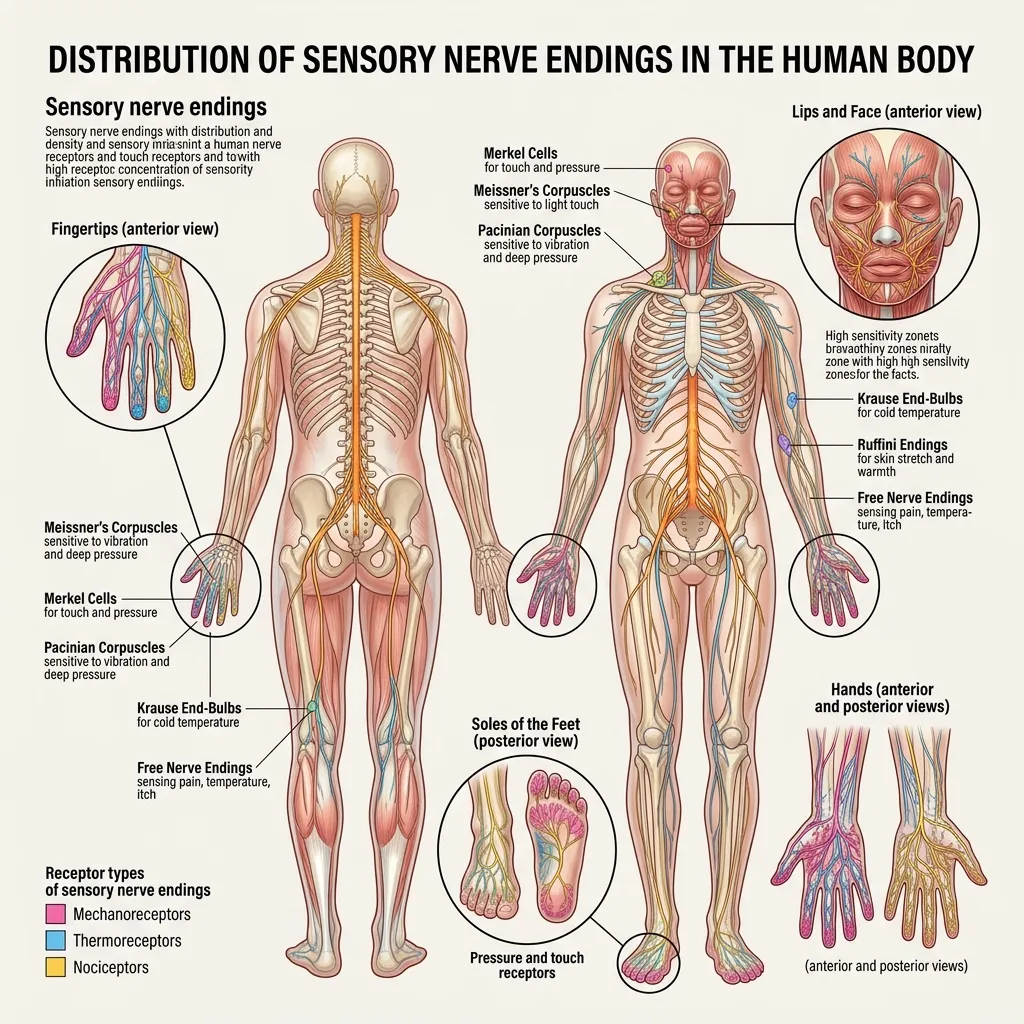
Free nerve endings are not limited to your skin. They appear throughout the body, both on the surface and deep inside. This wide distribution lets your nervous system monitor nearly every part of you.
Common locations include:
- Skin (epidermis and dermis): The largest concentration, especially for touch, pain, and temperature.
- Muscles and joints: Where they help detect strain, overuse, or injury.
- Internal organs: Where they signal pain from issues like inflammation or stretching.
- Cornea of the eye: One of the most sensitive areas, packed almost entirely with free nerve endings.
- Tooth pulp: The reason a cavity or cracked tooth can hurt so much.
This broad coverage is part of what makes free nerve endings so essential. Wherever damage might occur, these receptors are usually present to detect it.
How do cutaneous sensory receptors work?
Cutaneous receptors are sensory receptors located in the skin. They fall into two broad groups: encapsulated receptors and free nerve endings.
Encapsulated receptors have a capsule of connective tissue around the nerve ending. They tend to specialize in specific sensations like vibration, sustained pressure, or fine touch. Examples include Pacinian corpuscles and Meissner’s corpuscles.
Free nerve endings, by contrast, are unencapsulated. They handle the broader and more urgent sensations—pain, temperature, and crude touch. While encapsulated receptors give you detailed information about texture and pressure, free nerve endings focus on protection and survival.
Together, these two systems give your skin a rich and layered sense of the world. You can enjoy the soft feel of a blanket and still flinch away from a hot pan, all thanks to different receptors working at once.
How do free nerve endings fit into the peripheral nervous system?
The peripheral nervous system (PNS) includes all the nerves outside your brain and spinal cord. Sensory receptors in the PNS gather information from the body and send it inward. Free nerve endings are a key part of this sensory network.
A sensory neuron has three main parts: the receptive ending, the cell body, and the axon. In free nerve endings, the receptive ending is the bare nerve tip in the tissue. The axon carries signals from that tip all the way to the spinal cord.
From there, signals pass through the spinal cord and up to the brain. The brain identifies what the signal means and where it came from. This pathway—receptor to spinal cord to brain—is the foundation of how you sense the outside world.
Structure and function of sensory neurons
Sensory neurons are built to carry signals in one direction: from the body toward the central nervous system. Their long axons can stretch from your fingertips or toes all the way to your spine.
Many sensory neurons are wrapped in a fatty layer called myelin. Myelin acts like insulation and speeds up signal transmission. This is why sharp pain (carried by myelinated A-delta fibers) travels faster than dull pain (carried by unmyelinated C fibers).
The structure of each neuron matches its job. Fast pain needs fast fibers, so those neurons are thicker and myelinated. Slow, aching pain uses thinner, slower fibers. This clever design lets your body prioritize urgent warnings over background discomfort.
Why free nerve endings matter for your health
Free nerve endings may be small and simple, but their role is huge. They protect you from harm, help you respond to your environment, and keep you aware of your own body. From the sharp sting of a paper cut to the comforting warmth of a heating pad, these receptors shape how you experience the physical world.
Understanding how they work can also help you appreciate why pain, though unpleasant, is so valuable. Pain is a signal, not just a nuisance. It tells you to pull back, slow down, or seek help.
If you want to explore this topic further, consider looking into related areas like the gate control theory of pain, chronic pain conditions, or how pain medications target nociceptors. Each offers a deeper view into the remarkable system that keeps your body safe.
Frequently asked questions
What is the main function of free nerve endings?
The main function of free nerve endings is to detect pain, temperature, and certain types of touch. They convert these stimuli into electrical signals and send them to the brain, acting as the body’s warning system against potential harm.
Are free nerve endings the same as nociceptors?
Not exactly. Nociceptors are a specific type of free nerve ending that detects pain. All nociceptors are free nerve endings, but free nerve endings also include receptors for temperature and light touch, not just pain.
Why do free nerve endings have no capsule?
Free nerve endings lack a capsule so their nerve tips can respond directly to a wide range of stimuli. This bare structure makes them versatile, allowing them to sense pain, heat, cold, and itch without specialized coverings.
Where are free nerve endings most concentrated?
Free nerve endings are highly concentrated in the skin, especially the outer layers. They are also extremely dense in the cornea of the eye and in tooth pulp, which is why these areas are so sensitive to pain.
How do free nerve endings detect temperature?
Free nerve endings detect temperature using special ion channels called TRP channels. Some channels open in response to heat, others to cold. These same channels react to chemicals like capsaicin (heat) and menthol (cool), which is why peppers feel hot and mint feels cool.
What are free nerve endings made of?
Free nerve endings are the branching tips of sensory neurons. Unlike encapsulated receptors, they have no connective tissue covering, allowing them to respond directly to environmental stimuli.
Are free nerve endings found only in the skin?
No. Free nerve endings are found in the skin, muscles, joints, internal organs, cornea of the eye, and tooth pulp, where they help detect pain and other sensations.
What is the difference between free nerve endings and encapsulated receptors?
Free nerve endings are unencapsulated receptors that mainly detect pain, temperature, and itch. Encapsulated receptors are surrounded by connective tissue and specialize in sensations such as vibration, pressure, and fine touch.
Why are free nerve endings important for survival?
Free nerve endings alert the body to potentially harmful stimuli such as extreme temperatures, sharp objects, and tissue damage, helping prevent serious injury.
Can free nerve endings detect both heat and cold?
Yes. Different free nerve endings contain specialized ion channels that respond to either warm or cold temperatures, allowing the body to sense temperature changes accurately.
What happens when free nerve endings are damaged?
Damage to free nerve endings can lead to numbness, reduced sensation, abnormal pain signals, tingling, or increased sensitivity to touch and temperature.
Do free nerve endings play a role in itching?
Yes. Certain free nerve endings respond to itch-producing substances and send signals to the brain that create the sensation of itching.
How quickly do free nerve endings send pain signals?
Pain signals can travel at different speeds. Fast pain signals move through A-delta fibers, while slower, lingering pain signals travel through C fibers.
Are free nerve endings part of the central nervous system?
No. Free nerve endings are part of the peripheral nervous system and transmit sensory information from the body to the brain and spinal cord.
Can free nerve endings become more sensitive over time?
Yes. Inflammation, injury, or chronic pain conditions can increase the sensitivity of free nerve endings, causing normal sensations to feel painful or uncomfortable.